

I Am Henry Finch: Identity, Courage, and Thinking for Yourself
Jana Mohr Lone is PLATO’s Executive Director.
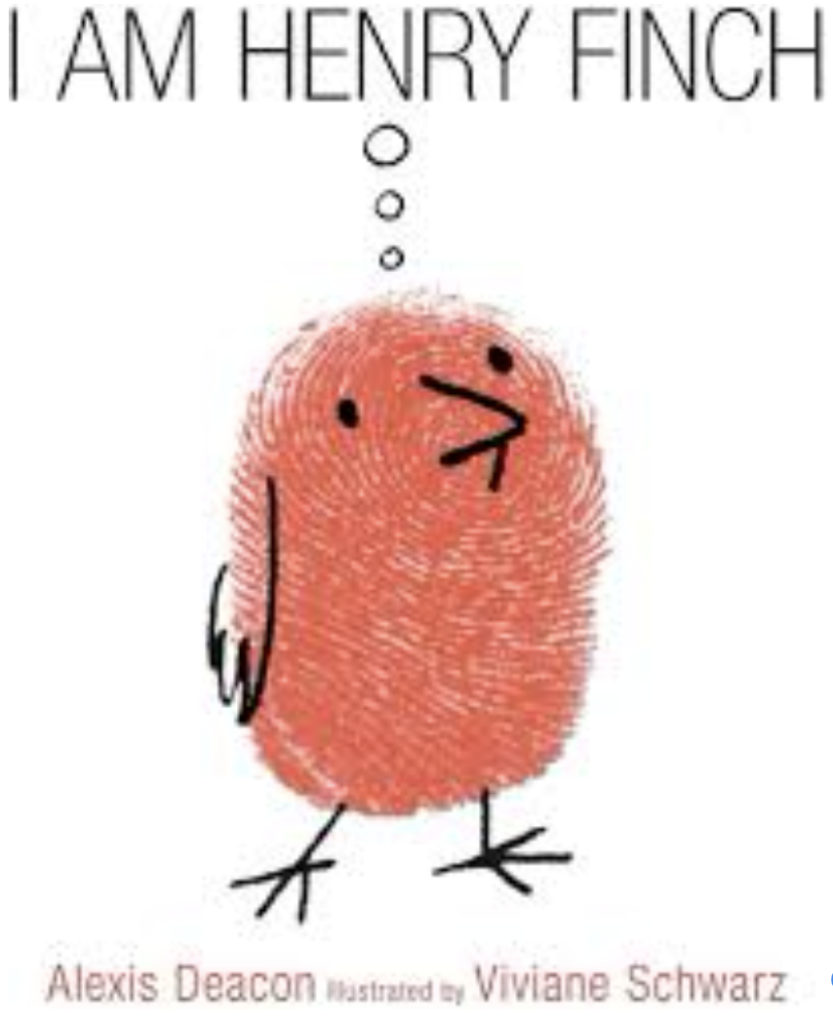
I Am Henry Finch by Alexis Deacon (illustrations by Viviane Schwarz) tells the story of Henry, a member of a community of finches, all of whom think and act alike. The flock is always together, and they do the same things, day after day. They are never quiet; in fact, they “make such a racket all day long, you really could not hear yourself think.”
One night, Henry wakes up and it is quiet. For the first time, he has a thought of his own, and he becomes aware that he is able to think. “I am Henry Finch,” he thought. “I think.”
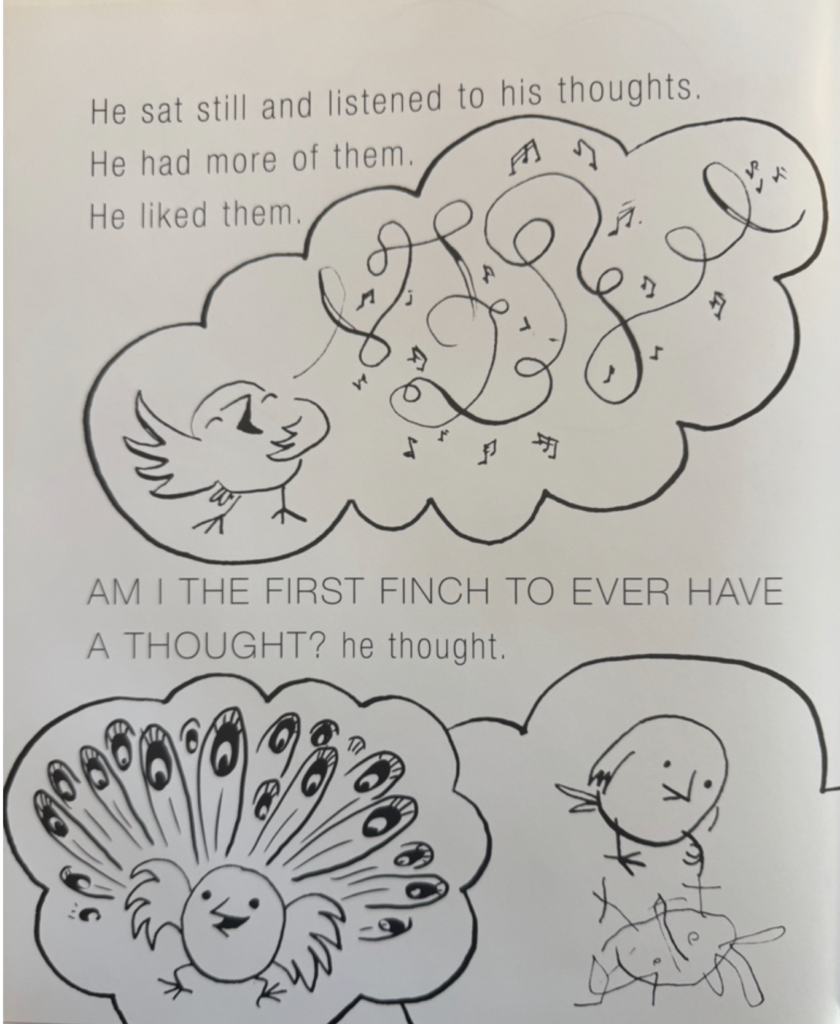
“I could be great,” he thinks. Becoming conscious of himself as an individual and not just a member of the flock, Henry starts to imagine the kind of person he might be.
The next morning the Beast appears, and Henry decides this is a moment for greatness. “I am Henry Finch,” he shouts, diving down at the Beast, who eats him.
Inside the Beast, the background of the pages has changed from white to black, and there is no color. Henry’s thoughts also turn dark. “You are a fool, Henry Finch,” he thinks. “You are not great. You are only someone’s dinner.” But as he continues to think, his thoughts deepen.
Henry begins to pay attention to the existence all around him. He realizes he can hear the Beast’s thoughts, which are focused on having a big family and needing to feed them. “Crawling, swimming, flying, walking . . . anything will do,” thinks the Beast. “No,” Henry says. He tells the Beast that all creatures have families, just like the Beast, and that the Beast should only eat plants from now on. The Beast acquiesces.
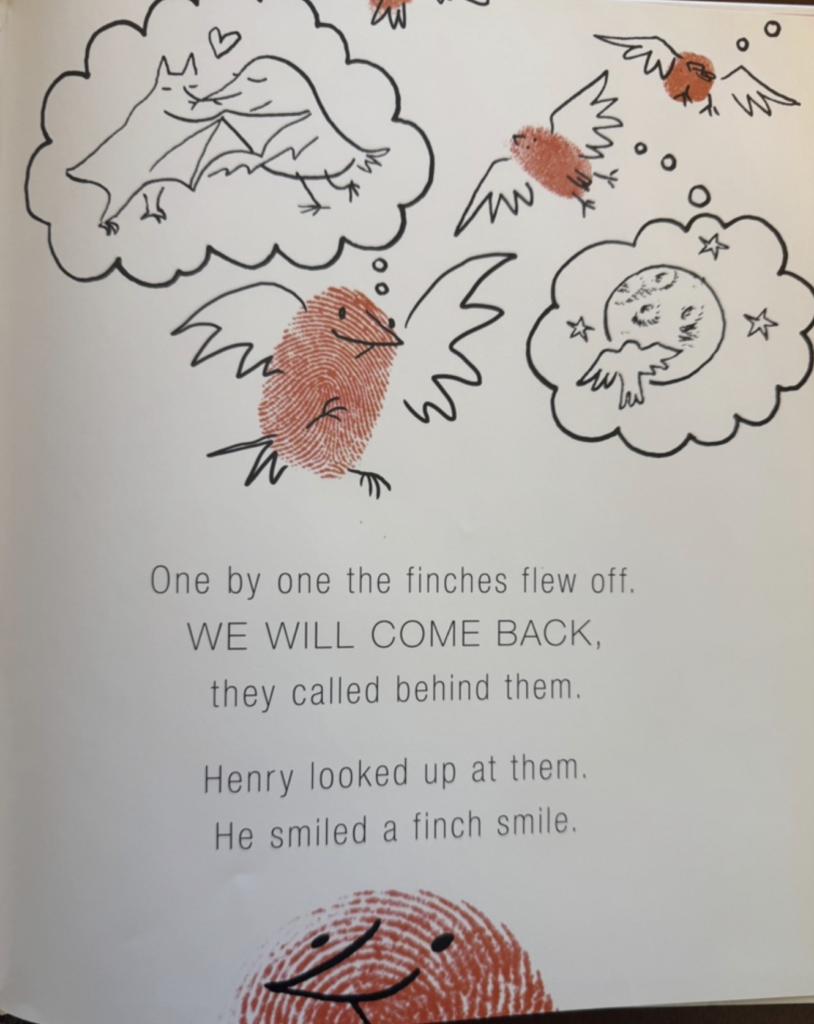
Henry then instructs the Beast to open his mouth so that Henry can fly out. Returning to his flock, Henry tells the finches that he has something to say, but first they have to be quiet. For the first time, they are quiet. They listen to Henry’s story, and then they stay quiet. One after another, the finches start to have their own thoughts, becoming their own individual selves.
The story raises many philosophical questions – ethical, metaphysical, and epistemological – including:
- What is courage?
- Is it wrong to eat other living creatures?
- What is the relationship between identity and thought?
- What do we need in order to think for ourselves?
- Is there a connection between solitude and independent thinking?
- What does it mean to be authentic?
- How do we define freedom?
- How do we balance the importance of individual choice and the need to conform to community norms?
- What does it mean to belong?
- What is the purpose of our existence?
The story’s echo of Descartes’ maxim “I think, therefore I am” reminded me of a discussion in a fifth-grade classroom some years ago. We had read a version of Plato’s Allegory of the Cave, and our conversation led us to Nick Bostrom’s simulation hypothesis. Bostrom argues that, given the likelihood that in the future advanced humans with powerful computers will be able to run “ancestor simulations,” creating virtual worlds populated by detailed simulations of ancestors capable of subjective experience, we are likely to be among the simulated minds.
The students acknowledged that it’s impossible to be 100% certain that we are not in a simulation. We wondered whether we should worry about this. Does it matter? And can we still claim to know that what we experience is in fact real (the sun is shining, for example)? We discussed whether absolute certainty is necessary for knowledge. Does the possibility that we could be simulated ancestors mean that we can’t know that we exist in the physical world in the way it feels to us that we do? And if we can’t know this, what can we know?
“Okay,” said a quiet ten-year-old girl sitting near the front of the room, “maybe I can’t know that I am not just the mind of a computer, or living in a cave and seeing only shadows. But what I can know is that if I’m thinking about what I can know, I can be sure that at least there is me thinking, even if that’s all I can know about myself or anything else.”
I told the student that the philosopher René Descartes had come to a similar conclusion almost 400 years ago. If I am thinking about this problem, at least I can be sure that I am a thinking being, even if I can be sure of little else.
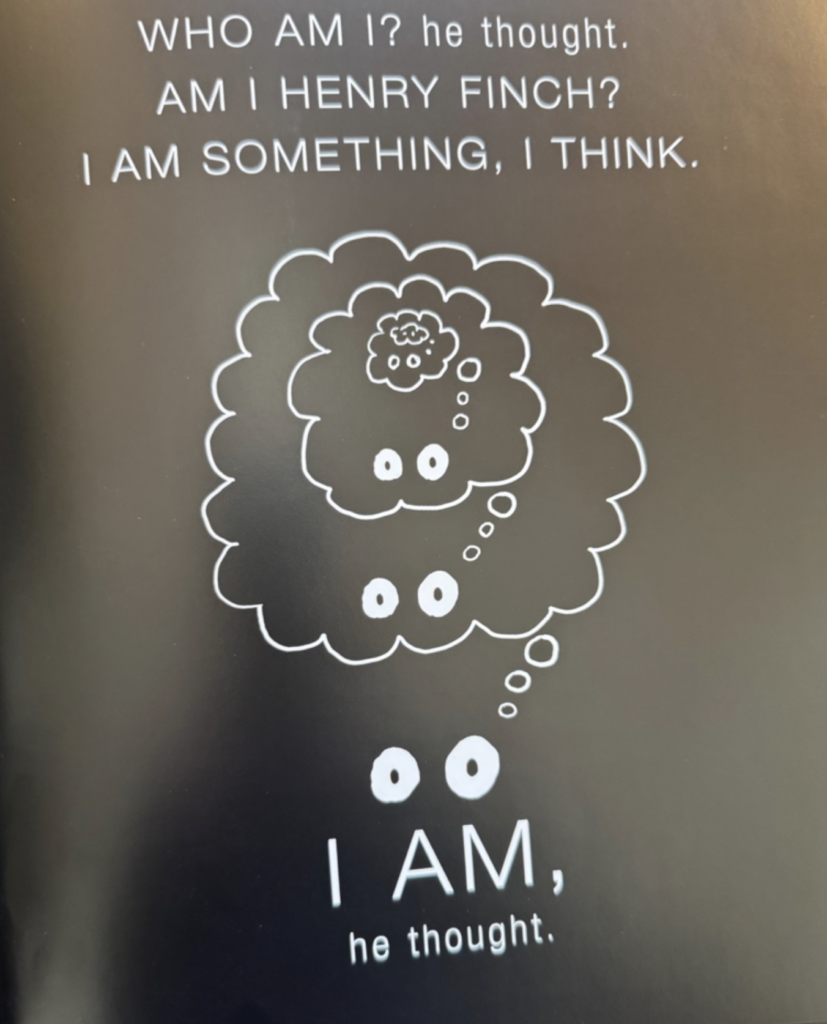
Henry Finch has a similar revelation. “I am something. I am.” He comes to understand that he is a thinking, independent being, with an individual identity. This realization leads him to true greatness.
Children often ask questions about identity and the purpose of existence. I Am Henry Finch is a wonderful entry point to thinking about these kinds of questions with students. And the thumbprint illustrations are an ingenious way to exemplify the uniqueness of every individual, human or finch.

