

Thinking Clearly Through Art
Karen S. Emmerman is PLATO’s Education Director.
Some readers of Wondering Aloud will know that I have a long-standing interest in building philosophical skills in ways that are joyful and themselves philosophical. To be together in a community of philosophical inquiry requires that we all articulate our ideas as clearly as possible and also ask for clarification when necessary. As an educator I know too well the look of confusion on students’ faces when I say something that makes complete sense in my own brain but fails to communicate much meaning to others. Over the years, I have learned to check in with students when I see those confused faces and to model what asking for clarity from another entails. Knowing that what we say needs to make sense to someone outside of ourselves is fundamental to the dialogical process whether in oral or written form.
In service of building the skills necessary to communicate clearly and ask for clarification from others, I developed an activity that I have called “Thinking Clearly Through Art” which is admittedly not a great name. I will happily take suggestions for alternatives in the comments section! Some readers might recognize this activity as a version of the exercise where people are asked to describe, step-by-step, how to make a peanut butter and jelly sandwich to others who must follow their directions to the letter, often with calamitous results due to imprecise directives. I had that exercise in mind as I developed this activity, but needed something more school-friendly, less messy, and more portable.
Thinking Clearly Through Art requires only one person to draw (they need not be a particularly good artist indeed the activity is better when they are not), a whiteboard, and a marker. In my sessions, I was the artist. I explained to the class that they were going to come up with something for me to draw and that they would need to tell me what to draw without telling me what the thing is. They could tell me shapes, directions, etc. but no hint of what the actual thing is, does, or sounds like. I then stepped out of the room while the students and their teacher decided what to tell me to draw.
Upon reentering the room, I asked the students to share what was in their minds about what I should draw. I made it a point to take them extremely literally. If they told me to draw a circle, but did not mention the size, I would draw a circle the size of a U.S. quarter. If they told me to “make a larger circle,” I would draw one only slightly larger in diameter. As the picture below shows, if they told me to “draw another rectangle,” I would put it somewhere else on the board entirely (see the upper left corner in the picture below). In the other picture below, you can see that the direction was given to “draw a bill,” so I drew a dollar bill. Doing this results in strange looking drawings – we had dogs with legs coming out of their heads, a duck with feathers perpendicular to their body, and a school building that looked like a prison (though truthfully, that may have been what the students were going for in that case). In one round we drew, erased, and redrew a single circle over twenty times as each student sought to improve on the communication of previous students.
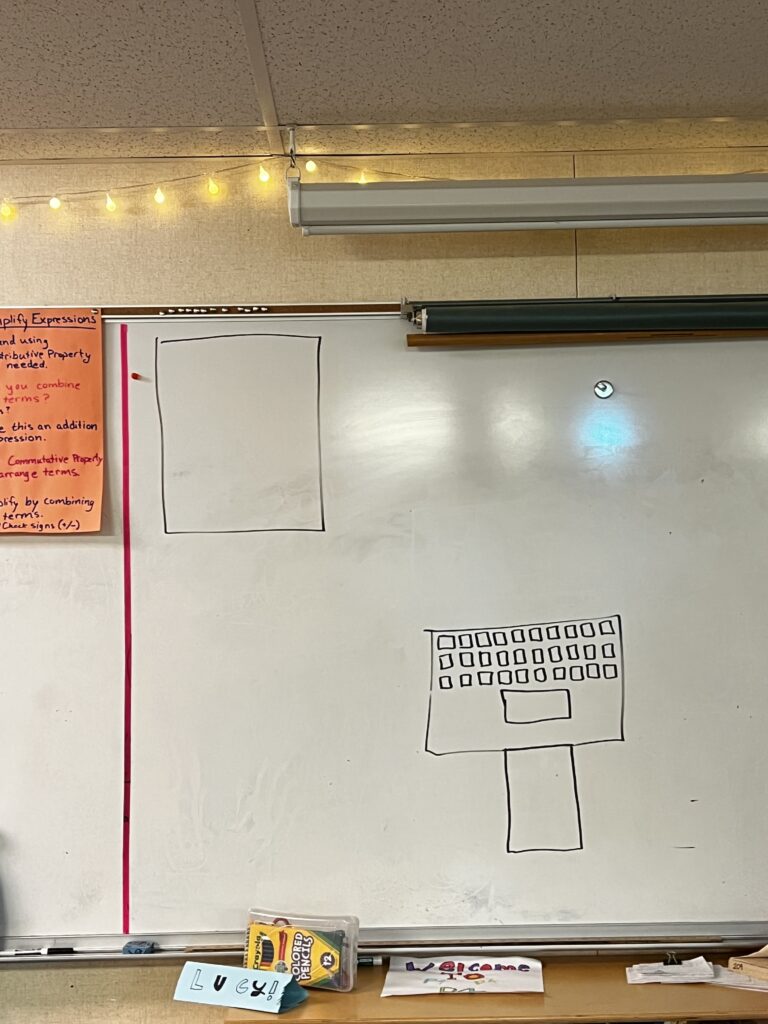
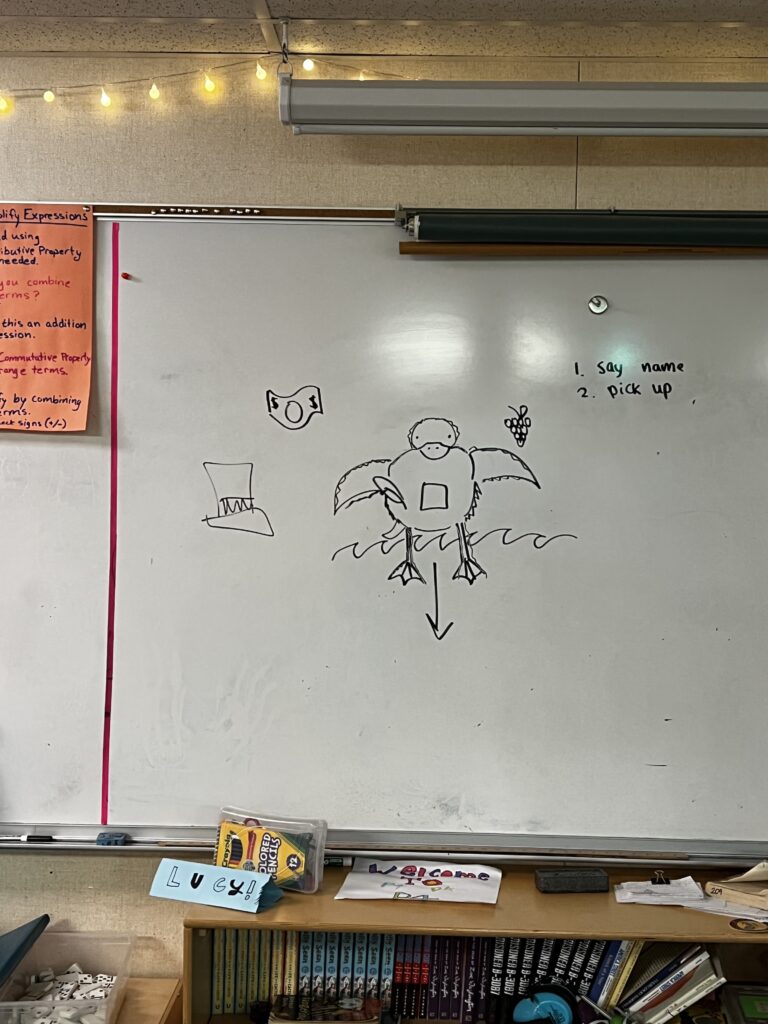
I did several rounds of this exercise in one session. After each round, I asked what they thought could go better, how they might articulate their ideas with more precision, and how they might work together to convey meaning. Interestingly, none of the students I worked with on this in four different classrooms ever suggested that I might have a role to play in aiding my own comprehension. At the end of each session I asked, “Is there anything I could have done to make this go more smoothly?” and was met largely with blank stares. “What if I had asked some questions of you all?” I prompted. That did the trick. The students began to realize the role of clarifying questions and how, even if we think we understand someone else, when it becomes clear that we did not we can always express curiosity to better understand their meaning. If, for example, I had asked “where does the rectangle go?” that out of place rectangle in the photo would be where it should have been all along.
The students loved this activity and often ask me if we can do it again. During the sessions themselves, many students requested the opportunity to be the “artist.” I declined those requests for two reasons: (1) I knew most students would want to draw and there was not nearly enough time for that, and (2) being the “artist” involves deliberately misunderstanding but only just enough to make the point about the necessity for clarity. A student could be coached into doing this well, but I lacked the time for that preparation. I can see a future use for this activity in rooms where we have already done the full exercise and we then use it as a warm-up where students have an opportunity to be the artist.
The activity brought the students real joy and a sense of fun while also working on the basics of what is required for clear and thoughtful communication, thinking about who carries the burdens for the effectiveness of communication (The speaker? The listener? Both?), and in my case it offered an opportunity to demonstrate some real humility. I am a terrible fine artist, so the students had a chance to see me off my game a bit, which is a wonderful way to remind them that we are all just learning from one another whether we are the adult in the room or the child.

