
A Silent Discussion about Love
Jana Mohr Lone is PLATO’s Executive Director.
The story Love, Z by Jessie Sima is about a young robot, Z, who finds a bottle with a message inside that is unreadable except for two words: “Love, Beatrice.” Z wonders what “love” means and asks all the other robots, but they do not know. Z decides to search for Beatrice, and along the way the robot asks various people if they know the meaning of love. Everyone has a different answer. Finally, Z ends up at the house of a woman named Beatrice. Asked what love is, Beatrice responds that love is hard to explain, but it is “warm and cozy and safe. You’ll know it when you feel it.” The robot hopes she is right. Later that evening, the other robots show up at Beatrice’s house looking for Z. They have brought Z’s favorite bedtime story, night-light, and a good night kiss. As Z is falling asleep, the feeling inside the young robot is familiar. But now “it had a name.”
I read this story with a group of fourth-grade students as the prompt for a silent discussion. (PLATO also offers a lesson plan for the book in our Picture Book Library.) In a silent discussion, students are divided into groups of three or four. Each group is given a poster board, and each student a Sharpie pen. The students communicate their thoughts and questions in writing and/or drawing during the activity, which is carried out in complete silence.
Before reading the story, I put the following questions up on the board:
- What is love?
- Can love mean different things to different people?
- Can you love someone you don’t like?
I told the students that these were possible questions for their discussions and they could use one or all of them, but they were also free to come up with their own questions.
After I read the story aloud, the groups of students spent about 20 minutes in silence, conversing in writing about the nature of love.
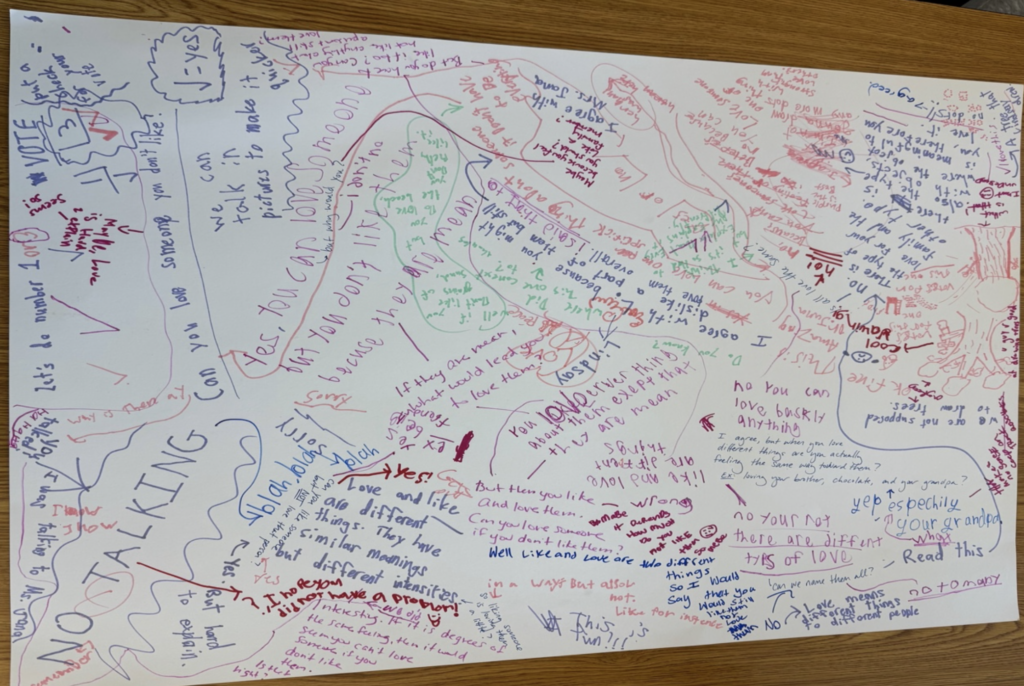
The written conversation can stray to wherever the students take it. If someone in the group writes a question, another member of the group can address the question by writing on the poster board. Students draw lines connecting comments to questions or other comments. I walk around and write comments or questions from time to time at the various tables.
In a silent discussion, more than one student can write on the poster board at the same time. Students often note that, unlike in a large group verbal discussion, in a silent discussion nothing is lost. You have a thought or a question, and you write it down, and the group can return to it at any point, as opposed to a verbal conversation that moves on from one subject to another. There is a spaciousness to the activity that fosters creativity and a sense of ease, allowing for the free and relaxed expression of ideas.
Some examples from the boards:
“Can you love someone if they really hurt you?” “Well, if you love someone, you love someone, right?”
“Can we choose who we love?” “Yes, but not always.” “I don’t think so. I think it just happens.”
“Do animals love?” “How could we know?” “Maybe they do, but they don’t understand love.”
“I loved my chickens when I had them. I think that’s what love feels like.”
After about 20 minutes, I let the students know that, remaining in silence, they can now walk around the room and read the other tables’ poster boards, adding written comments as they see fit. After this part of the activity, they are able to debrief verbally with their original small group. Then we come together as one large group to discuss the activity and the philosophical ideas that emerged.
In the large discussion that ensued, a couple of students observed that silence and the opportunity to write down their ideas gave them more space to think before they had to communicate than they usually experience. One student said that she often feels rushed in large group discussions because she knows other students are waiting to speak, and that in this activity she could take her time. “It let me think more clearly,” she noted.
We talked about how sometimes it is the concepts with which we are most familiar – like love – that turn out to be the most perplexing. Several students commented that they had never really thought about what love means and that the activity led them to realize that it was not easy to define.
“I know what it feels like,” one student stated, “but I don’t know how to say what I think it means.”
“I feel like my head is going to explode,” another student said.
In every philosophy class I lead, I always hope that students come away with an appreciation for the perplexity of the ordinary. For the things that we assume we understand, until we start to think about what they really mean. This awareness can be a source of richness and depth our entire lives.