philosophy for children

I know a lot of things

Ann and Paul Rand’s picture book, I know a lot of things, captures a young child’s exuberance about the things he or she knows – such as “when I look in a mirror what I see is me.” Graphic designer Paul Rand’s illustrations enhance the inquisitive feel – looking at us from the mirror, for I know a lot of things

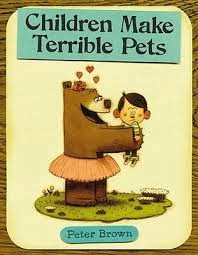
Children Make Terrible Pets

Children Make Terrible Pets, Peter Brown’s picture book about a young bear, Lucy, who one day notices a small boy hiding in the bushes and watching her. Lucy thinks the boy is adorable, calling him “Squeaker” because he “makes funny sounds.” She asks her mother, who reluctantly acquiesces, if she can keep Squeaker as a Children Make Terrible Pets

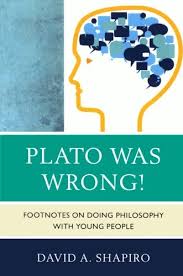
Plato Was Wrong!

The Center’s Education Director, David Shapiro, has written a wonderful book – Plato Was Wrong! Footnotes on Doing Philosophy With Young People – that compiles activities and games he’s created over the years to inspire philosophical inquiry with young people. These activities can be used as a starter in a philosophy session or as the Plato Was Wrong!

Children’s rights

The book For Every Child, published in 2001 in association with Unicef, with text by Caroline Castle and a forward by Archbiship Desmond Tutu, lists some of the rights enumerated in the U.N. Convention on the Rights of the Child, in accessible language and with magnificent illustrations by 14 different artists. For example, the rights Children’s rights

Just Pretend

Benny and Penny in Just Pretend, by Geoffrey Hayes, is an early-reader graphic novel about two siblings and the efforts of the younger child, Penny, to join her brother in “playing pretend.” Constructing pretend worlds is part of many children’s childhoods – I remember when my children wouldn’t answer me unless I addressed them as Just Pretend

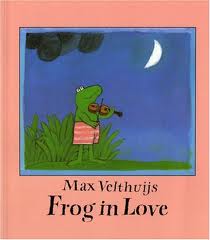
Frog in Love

Frog in Love by Max Velthuijs is the story of Frog, who has felt strange all week, and is trying to figure out what is wrong. He feels like crying and laughing at the same time, and that “there’s something going thump-thump” inside him. When he tells Hare about how he is feeling, Hare tells Frog in Love

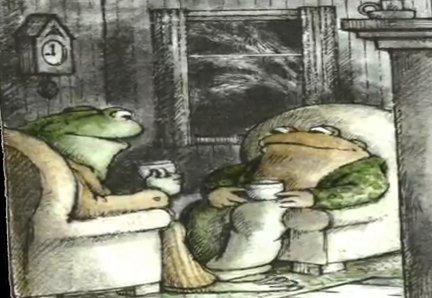
“Shivers”

Arnold Lobel is probably my favorite children’s book author, and a master at generating philosophically suggestive narratives. The Frog and Toad books, in particular, are full of stories that raise many puzzles about life and experience. One of my favorites is the story “Shivers,” in Days With Frog and Toad. Frog tells Toad a ghost “Shivers”

A Pair of Red Clogs

A Pair of Red Clogs is Masako Matsuno’s first book for children, written in 1960. A grandmother, looking for a box to send a new pair of clogs to her granddaughter, finds an old pair of cracked red wooden clogs in her storeroom. The grandmother remembers how excited she was when, as a child the A Pair of Red Clogs

Asking Questions

I have written in many places about the centrality of questions to the work we do, and the importance generally of children learning to ask good questions and trusting that their questions are valuable. Almost all very young children are alive with questions; they seem to naturally apprehend that this is the way to investigate Asking Questions

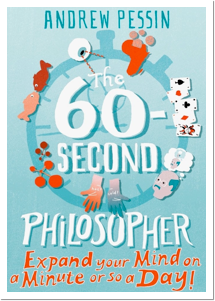
The 60-Second Philosopher

Andrew Pessin’s The 60-Second Philosopher is a series of 60 very short chapters (each two pages) that provide ideas for thinking about a wide range of philosophical topics (time, color, various ethical questions, knowledge, free will, etc.). The first chapter, “The Philosopher Within You,” begins: There’s the legend of the fish who swam around asking The 60-Second Philosopher