

Monster at School
Karen S. Emmerman is PLATO’s Education Director.
Thinking philosophically requires, among other things, developing a set of philosophical skills. Doing philosophy in elementary schools (students between 5 and 11 years old) for over a decade has drawn my attention to just how important it is to help young people build these skills. For the youngest philosophers, we often need to practice asking questions and giving reasons before we can begin doing more complex philosophical thinking together. Others need some time to learn how to give reasons and evaluate others’ reasons. I spend a good deal of my time as a Philosopher-in-Residence contemplating what skills are needed and how to work on them in a way that holds true to the values of creating a Community of Philosophical Inquiry. In particular, I do not want sessions focused on skills-building to feel like a “lesson” where I am imparting wisdom for the students to absorb passively.
Fortunately, there are many wonderful ways to build philosophical skills that promote student-centered inquiry. Among my favorites is Sarah Stanley’s “Monster at School” exercise. Stanley recommends drawing a monster that looks neither friendly nor scary and has a closed mouth, 3 arms, 4 legs, and a tail. I asked my then 13-year-old son to draw the monster for me (ask my students – I cannot draw!). He didn’t follow the rules entirely, but the result was excellent.
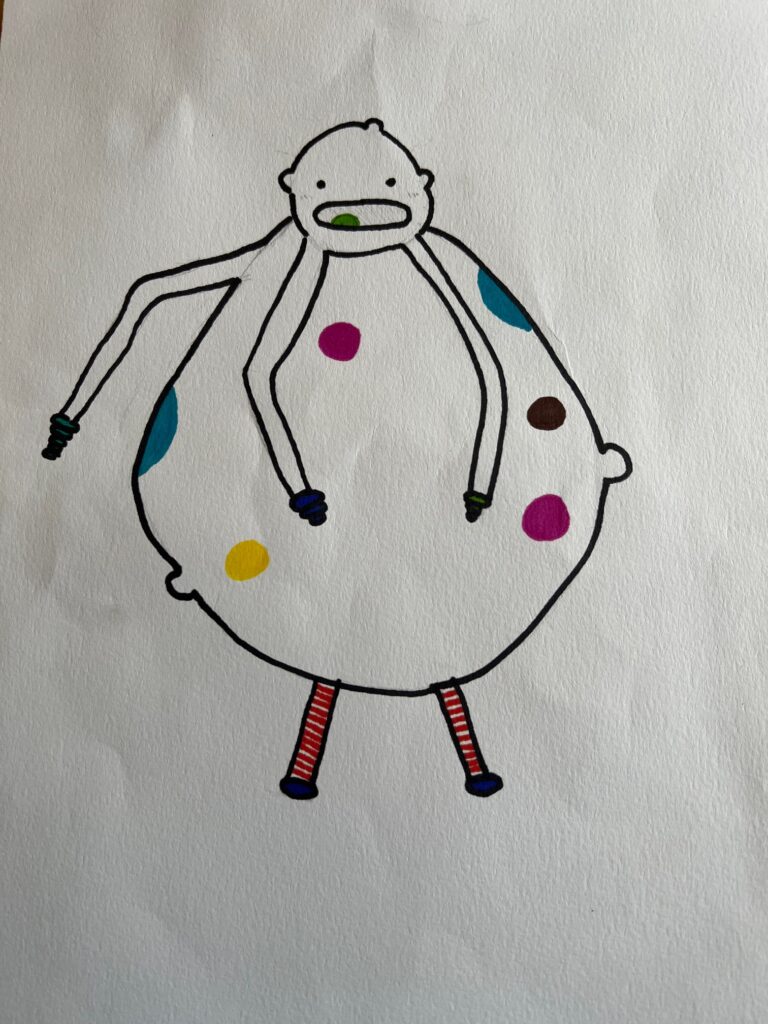
The facilitator presents this monster to the students with a short story about how they met the monster last night and that the monster would like to come to school tomorrow. The students then break into groups depending on whether they think the monster should or should not come to school. When I do the exercise, I offer the option for those who are unsure to make their own group. The students have an opportunity to share their thoughts with one another before we re-group as a whole. From there, I make “yes,” “no,” and “maybe” lists on the board, gathering their thoughts.
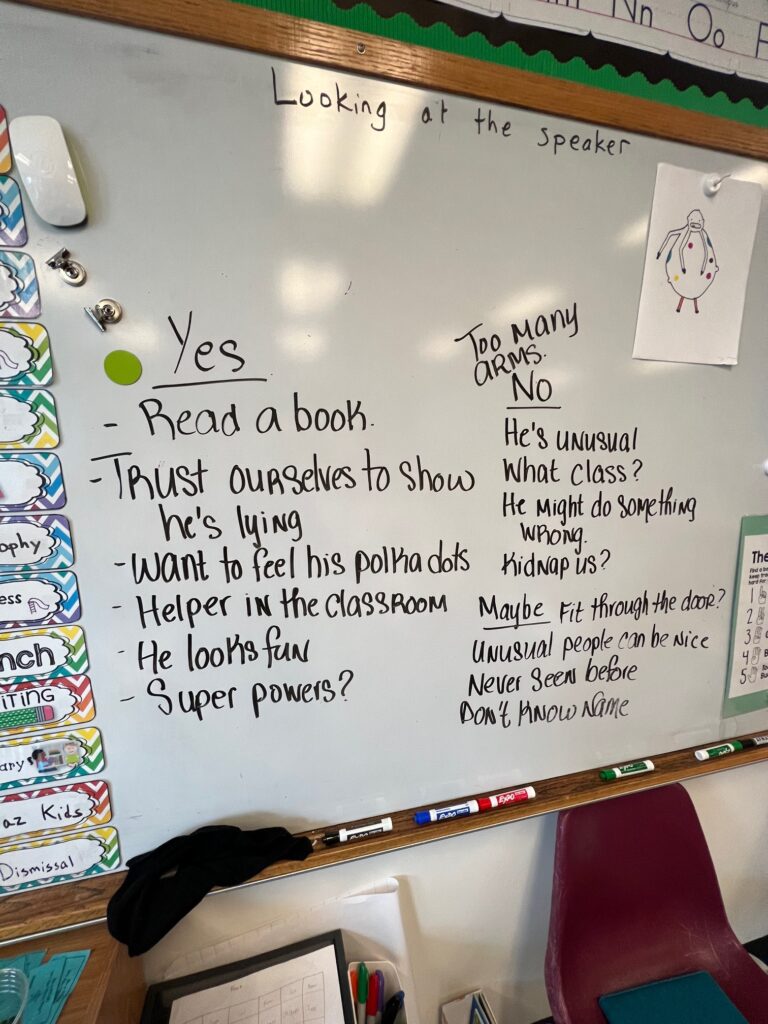
Once their ideas are on the board, I begin one of two ways. For students ages 5 or 6, I re-read what is on the board under one of the columns and then ask why one of the items listed there seems important. Often, the students will point out that the monster has too many arms. Interestingly, the extra appendage is sometimes considered a point in the monster’s favor and sometimes a point against them. I ask, “Why would how many arms the monster has matter for whether we let them come to class?”. For older students, I invite them to find something on the lists that does not make sense to them or that they have a question about. For example, a student might ask why it matters that the monster “looks like a potato spider.” In both cases, the students have an opportunity to share their reasons, think together about whether those reasons make sense, and evaluate what we really need to know about someone in order to trust they are safe to be around. We also discuss whether judging by appearance is good practice or fair.
We also work on the skill of clarification. In one room, students suggested that we need to know if the monster is good with children. I asked whether the monster only needs to be good with children or would they need to interact well with others as well. The students clarified that the monster needs to be good with all people since substitute teachers need to work with adults as well as students. This prompted a discussion of all the things teachers need to do and whether the monster could, in fact, do all those things. Several assumptions about differently abled people arise, making this discussion a wonderful way to question our assumptions (e.g., “do we know for sure that someone with a big body and short legs cannot walk up the stairs? Why would we assume they cannot?”).
Over the years, I have changed the exercise a bit to ask if the monster would be a good substitute teacher rather than whether they can simply visit the school. This slight alteration allows for another philosophical element to come to the fore: what qualities we think are important in teachers. Recently, in a first-grade classroom, several students were enthusiastic about the monster substituting for their class because they thoughts he “seems dumb,” “would let us do whatever we want,” and “would let us watch movies!”. This afforded us the opportunity to think about what we need from a teacher as well as how someone could look like they do not enforce rules.
Building philosophical skills is essential for successful philosophy sessions, but it need not be tedious or boring. With creative exercises and careful facilitation, students can build the skills they need while enjoying all of the student-centered benefits of a community of philosophical inquiry.

