

Inclusivity and Difference

Lesson Plan
Warm-up
While technical issues with the video are being handled, allow participants to choose their art supplies and explain that they are free to make art while participating in class and listening to each other. Invite participants to think about their hopes, goals, and fears about participating with the group.
Stimulus (9 minutes)
Watch video of The Day the Crayons Quit
Discussion
Keep the artist’s final picture up on screen and invite participants to notice how the crayon’s feedback was incorporated. Keep the picture up while the group begins to discuss and develop themes that can be applied towards the group’s goals.
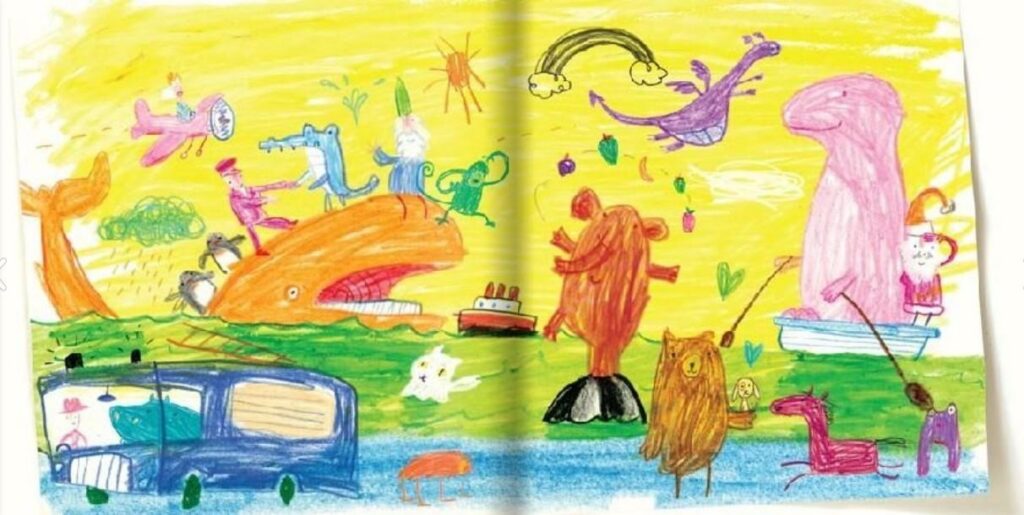
Depending on time constraints and other limitations, it may be beneficial to focus the discussion by stating the goal and offering a leading question to help start the group discussion. Some examples are:
A philosophical discussion goal* could be specified with an initial question: Let’s consider ways we can create inclusive groups [GOAL]. What assumptions do we have about including everyone’s differences [QUESTION]?
A class/group-rules leading question could be: Let’s think of how we’d like to participate in class this semester and how we’d like to be treated [GOAL]. What are some ways that we can create a happy and productive space to learn in [QUESTION]?
A collaborative team project: Let’s think about the project at hand and how you’d like to participate [GOAL]. What do you find inspirational about the project and what do you have a passion to develop [QUESTION]?
Notes and tips to facilitator
Choose art supplies that are near universal in the childhoods of your community. The idea is to incorporate the sensory experience of smells, textures, and sounds evocative of a child’s creative process.
Use an open-ended format to track the development of themes from your group’s discussion. These may be mind-maps, or a listing of keywords.
Support the group’s decision-making process with clarifying questions and restating what you hear. Be open to re-defining/re-grouping themes. Avoid deputizing students and assigning associations. Allow groups to form naturally and allow students to work independently. If needed, model stating needs openly and asking for help.
Guided discussion of philosophical issues
Choose 1-3 questions (depending on time) from the list of Discussion Questions.
For an additional resource, see Senses-Based Learning, an education resource in the Netherlands.
Discussion Questions
- What assumptions interfere with including everyone’s differences?
- If it is impossible to incorporate everyone's feedback, what is a fair way to decide whose feedback is acted on?
- In the story, Duncan makes the final decision. Do groups need to have a single person or a small group to make a final decision?
- What enables people to speak out when they think they think they are being mistreated?
- How can we know if someone in a group is being mistreated?
Resources
This work is licensed under CC BY-NC-ND 4.0
If you would like to change or adapt any of PLATO's work for public use, please feel free to contact us for permission at info@plato-philosophy.org.

Connect With Us!