
A Week in the Life of a Philosopher-in-Residence
Karen S. Emmerman is PLATO’s Education Director.
As the end of the school year in Seattle approaches, I have been thinking about my role as Philosopher-in-Residence (PIR) and how it plays out over the course of a week. I tend to think in daily increments rather than weekly, focusing largely on what classes I will see this day, what we will do, what we did do, and so forth. Looking at the week of facilitating as a whole, I get an entirely different perspective including a chance to look at how the project of thinking philosophically with young people manifests differently depending on the ages and developmental stages of my students while also serving the same goal—building a community of philosophical inquiry—regardless of age. Let’s walk through a week together to demonstrate what I mean.
At Thurgood Marshall Elementary School, I teach one kindergarten class, a third-grade class, two fourth-grade classes, and three fifth-grade classes. Due to scheduling, I am often bouncing between grades rather than seeing, say, all of the fifth-grade classes on the same day back-to-back. Thus, I think in terms of work I do in different grade classrooms rather than by day of the week so that is how I will lay it out here.
Kindergarten – In this class I work with a significant number of multilingual learners as well as students who are new to schooling. I spent several weeks early in the year working on the basics of dialogue: practicing asking questions (kindergarteners often do not know the difference between making a statement and asking a question), expressing an idea, giving reasons, and the nature of agreement/disagreement. For this week, it was time to put those skills together and start practicing doing philosophy. I chose an activity I developed called “Alive/Not Alive” where I write the name of various objects and beings on index cards and put papers on the carpet saying “Alive,” “Not Alive,” and “???” (for “I’m not sure”). We sit on the carpet and I produce an index card that says, for example, “car.” Then we discuss whether a car is alive or not and why we think that. This combines all the skills we have been working on regarding sharing ideas, asking questions, and noticing agreement and disagreement while also providing an opportunity to think about what it means to be alive and what we think is required to count as alive.
3rd Grade – My third graders already have a keen sense of what it means to think philosophically together. I my goal for this week was to find an interesting way for us to dig into some fundamental questions of life more deeply. This led me to choose my “Wants versus Needs” activity both because it is philosophically rich and because this group of students needed some practice tolerating quiet, independent thinking time. They are all about the enthusiastic shouting out over one another’s thoughts and not fans of quiet reflection. For this activity, students spend some time on their own thinking about some things they want, some things they need, and the difference between wants and needs. We get a list of wants and needs on the board from the independent work and then think together about those categories and whether the suggestions belong in the category in which they were placed. We talked about whether art supplies count as a want or a need given the importance of art in some students’ lives. This led us to wonder if the need is supplies or if the need is actually better described as access to art. Right on time, a student asked whether we are talking about needs that are required for basic survival or other kinds of needs, noting that we had not specified. This question is a delightful sign that philosophical thinking is taking hold as students notice on their own the need for clarification and the importance of recognizing seemingly subtle differences that in fact make a tremendous difference in how we think about a question or problem.
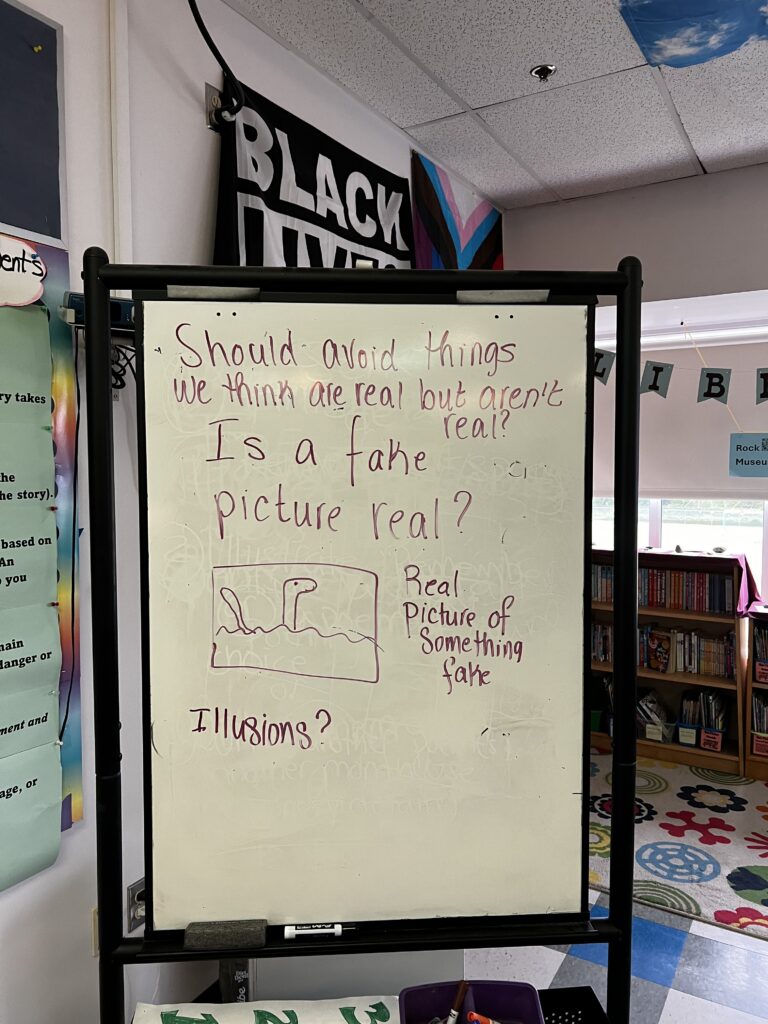
4th grade – I see one fourth grade class at the start of the school day and another at the end of the school day. These are not ideal times for philosophy as the students are tired at both the beginning and of a school day. When planning for these classes, I aim to find activities they will find quickly engaging. On this week, I chose the wonderful “Reality Scavenger Hunt” developed by my colleague, David Shapiro. Students are presented with a list of “items” to “find” that are actually metaphysical thoughts they can think of (e.g., something that is real but seems not to be and something that doesn’t matter if it is real or not). The students work on their own to come up with answers to each prompt. Then, a student shares an answer, and the class tries to work out which category of reality it belongs to. In one of the classrooms we had a long discussion of what makes a unicorn a unicorn and whether a narwhal counts as a unicorn. In the other class we thought about whether a picture of something fake is real and whether we should make decisions to avoid things that we are not sure are real (e.g., planning a trip to avoid the Bermuda Triangle).
5th grade – These are my most experienced philosophers. We had been doing some book-based prompts with open inquiry for a few weeks, but I noticed some of their reasoning was a bit sloppy. I thought they could do better but needed a chance to practice in a low-stakes way so I turned again to David Shapiro for inspiration and landed on a modified-for-time version of his “What’s Your Reason” game. Students write a belief they have on one side of an index card and, on the other, write three reasons they believe that belief. The class is split into two teams. Reading just one of the reasons, students are tasked with guessing what the belief is. They get three chances to do so, with each turn adding in another of the reasons on the card. One student’s card looked like this:
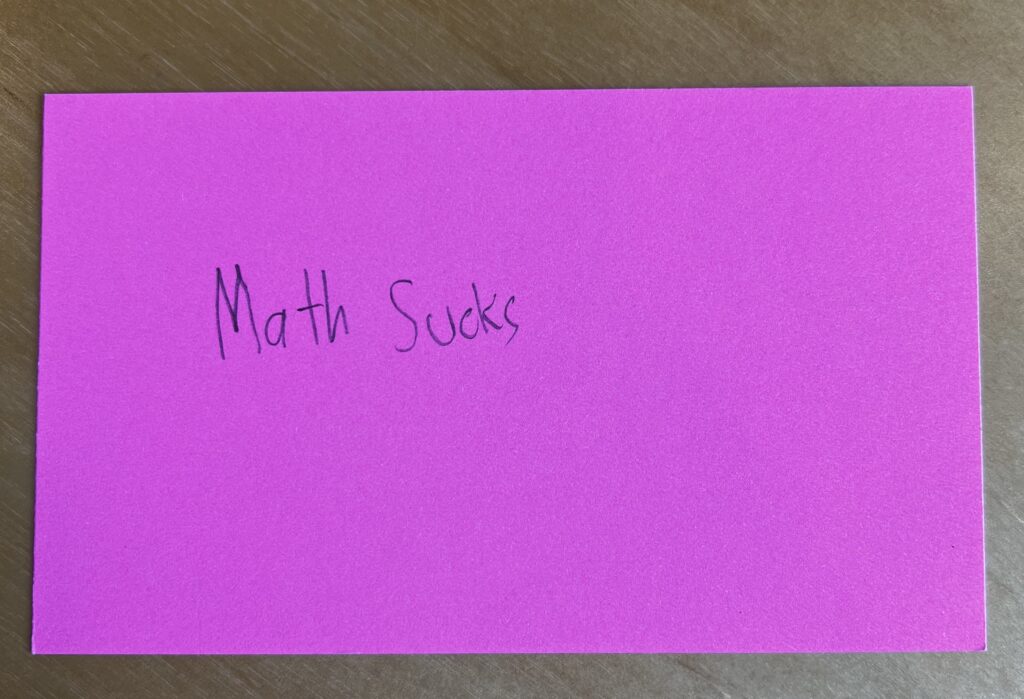
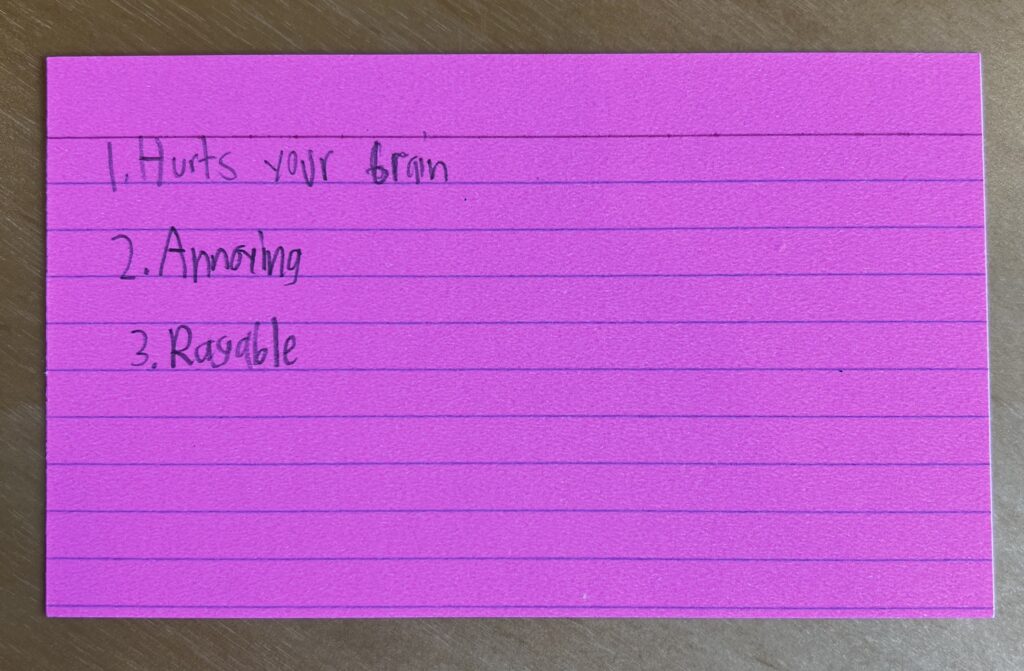
Cards like these provided ample opportunity to discuss the necessity of specificity in reasoning. “Hurts your brain” could be about anything. So many things can hurt our brains and what hurts your brain might not hurt mine. What happens if we change the reason to “Doing math hurts your brain”? Thinking along these lines, students worked to refine their thinking. I decided the next week to do an exercise where students construct an argument to convince their principal of some change that needs to be made at the school so we could keep developing their critical thinking skills.
Thinking in terms of a whole week rather than a singular classroom, I see themes. These include meeting students where they are, combining inquiry with skill building, generating discussion in ways that are interesting for students, and working together to make progress over time. This is one of the very best gifts of the PIR program, allowing a facilitator to get to know a whole school community, thinking of the students as developing philosophical interest and skills over time, and knowing students well enough to put together a curriculum that brings joy, has philosophical merit, and focuses on where they are in their development of a community of philosophical inquiry.