
Practicing Philosophy with Kids in the Shenandoah Valley
Dr. Anne van Leeuwen is an Associate Professor of Philosophy at James Madison University.
In her now classic book on pedagogy, bell hooks writes that education is enabling, that it “enhance[s] our capacity to be free.”1 Studying philosophy embodies this promise of freedom and equality precisely because it encourages a use of reason that is radically unconstrained. This is what Immanuel Kant famously described as the “public use of reason”—reason that is not circumscribed by any foundational axioms or determinate boundaries. Yet attempts to popularize philosophy are sometimes met with suspicion and resistance, as if accessibility can only be achieved at the cost of rigor and depth. It is perhaps unsurprisingly, then, that philosophy is seldom part of a K-12 curriculum in public schools, as if serious philosophical questioning is inaccessible to children.
There is something profoundly unphilosophical in this position, however, as Gareth Matthews points out in his wonderful book, Dialogues with Children:
“Talking to children is nothing new. As parents, grandparents, teachers, neighbors, and casual acquaintances, we talk to children all the time…What we adults don’t do, when we talk to children, is discuss matters we ourselves find difficult or problematic.…What has not been taken seriously [in other words], or even widely conceived, is the possibility of tackling with children, in a relationship of mutual respect, the naively profound questions of philosophy.”2
During 2025-2026, as part of a work-based learning experience and with PLATO’s support, undergraduates at James Madison University developed an after-school philosophy club at Spotswood Elementary School.
“How can you teach philosophy to an eight-year-old?” my colleagues sometimes ask. I don’t know whether you can or cannot, I tell them, but that’s not what we’re doing! Instead, the club has created a space for philosophical dialogues to take place, sometimes using words and sometimes using pipe cleaners, cardboard boxes, or photography as a medium in which we think through an idea. We never ask questions to which we already know (or think that we know) the answers; instead, together and with mutual respect, we take up, these “the naively profound questions of philosophy.”
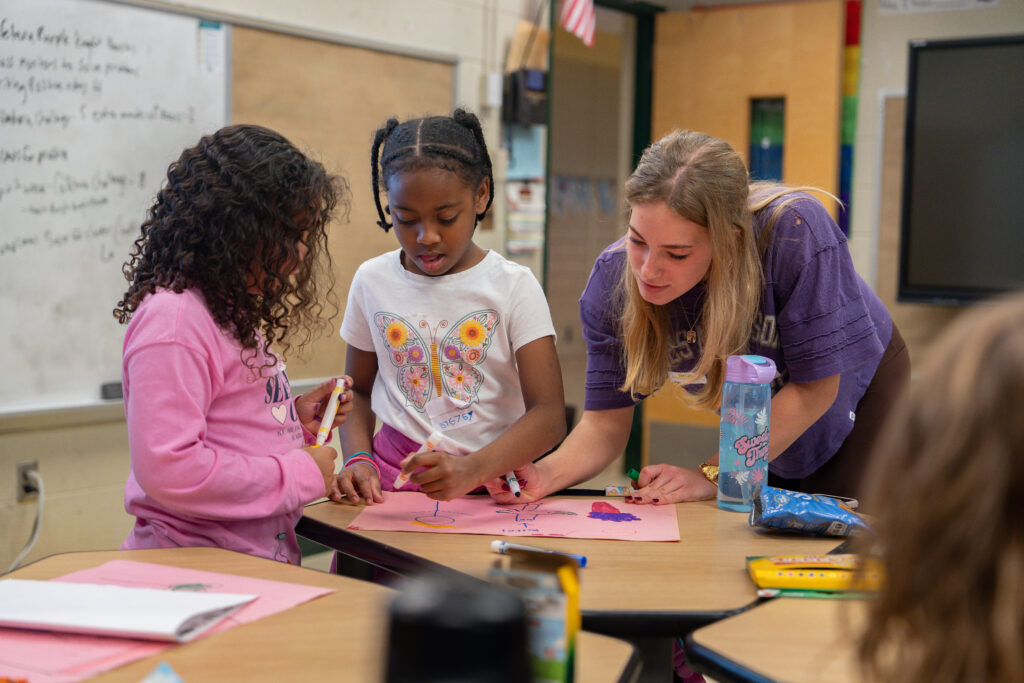
For example, during one meeting, we read “Dragons and Giants” from Arnold Lobel’s classic story collection Frog and Toad Together. Then, a JMU student produced a box with a hole cut into the side that was hidden by a removable cover. “There is a spider in this box,” the JMU student said. “Without looking, who wants to put their hand in the hole on the side for three seconds?” Almost universally, the students were convinced that there really was a spider in the box. Some volunteered, some did not, but they all loved the “scariness” of the challenge.
After all the volunteers stepped forward, all the students learned that there was no spider in the box. This led to an impassioned discussion about bravery: Do you need to be afraid to be doing something brave? If you didn’t believe that there was a spider in the box, was it brave to put your hand inside? Is it brave to do something that scares you? Is it brave when the risk involved is in some way unnecessary? Is it brave to be the only one not to do something that you consider foolhardy?
During another club meeting, a discussion of Mac Barnett and John Klassen’s Extra Yarn, led us to talk about the difference between the finite and the infinite. Each student was given a bag of yarn and challenged to figure out a way to make the yarn infinite. At first, they told us that it was impossible, and then they slowly began to develop ideas. In yet another meeting, after reading Shel Silverstein’s The Missing Piece, we asked the students to construct a simple object from Legos and then pass it to the person seated beside them, who would change it and pass it on. This led into a discussion of what in Hegelian terms we might call “the work of the negative” without using any philosophical concepts to thematize this.
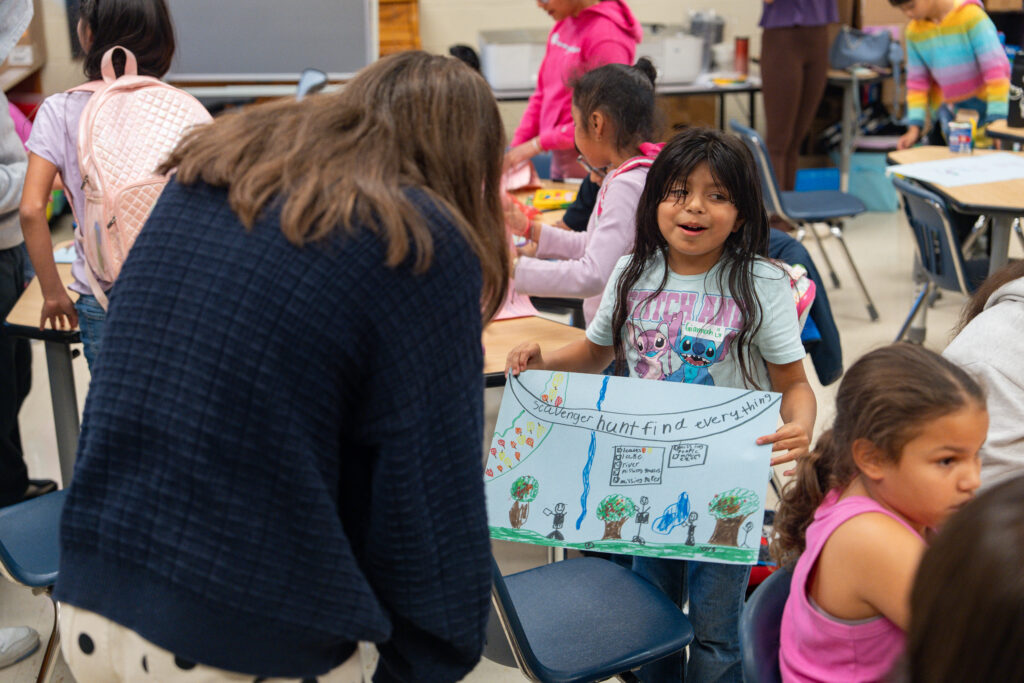
The profound curiosity and intellectual openness I’ve seen working with young students is what Jacques Rancière describes in The Ignorant Schoolmaster as the will to learn — a willingness to engage in dialogue together about open-ended questions and abstract ideas. Rancière provocatively argues that the will to learn and not an explication of these ideas is the condition during which learning takes place.
Part of building a space for philosophical dialogues involves creating a sense of trust and community with our students. In other words, this is not a project to be taken up for a couple of weeks but a long-term effort, nor is it simply an academic exercise but connected to their overall flourishing. As we got to know the elementary students better, we saw that they became increasingly invested in the project. Accordingly, I visit these students at lunch time in the cafeteria, I see them on the playground, and in their school performances or plays. This way, practicing philosophy in the philosophical community that we create together is integrated into their experience in public school.
Practicing philosophy with young children has in turn impelled me to teach my university classes differently and to approach them with a renewed sense of optimism even in the face of new challenges such as generative AI. I am convinced that, as bell hooks argues, the classroom, with all its existing limitations and increasing pressures remains a location of possibility.
- bell hooks, Teaching to Transgress, 5. ↩︎
- Gareth Matthews, Dialogues with Children, Harvard University Press, 1-3. ↩︎


What a profound way to lead students to a deeper understanding and interpretation of the meaning of various concepts! Great way to help our minds to go deeper! Well done!